
New PEFC ST 2001:2020 (Second Edition): what this means for your use of the PEFC trademark
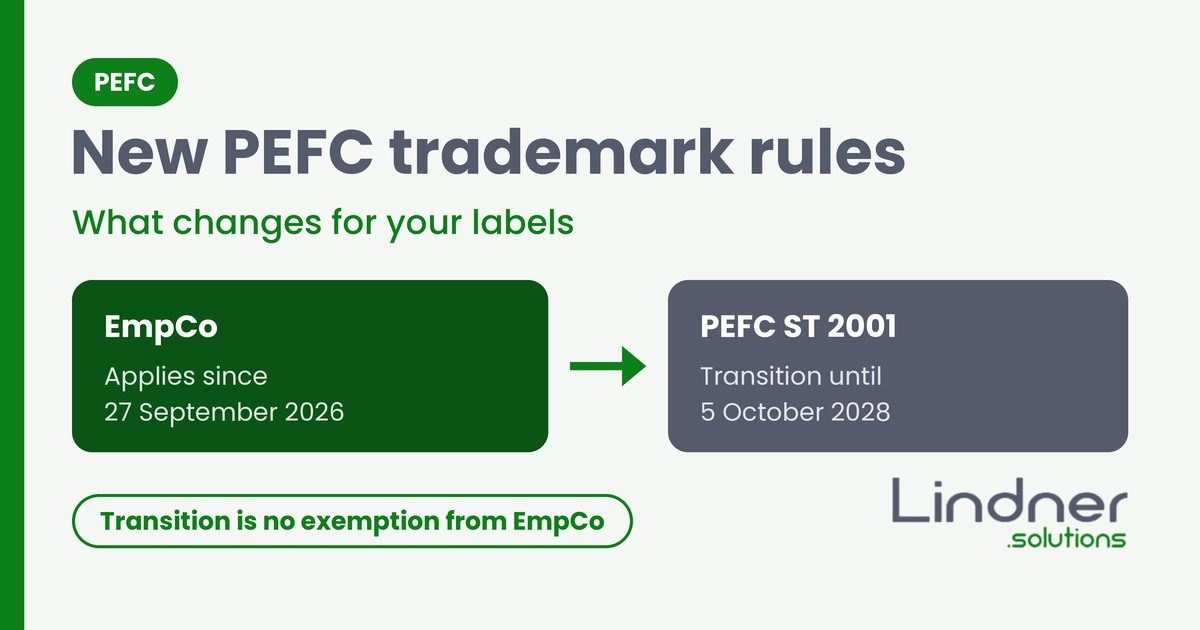
On 5 October 2026, the second edition of PEFC ST 2001:2020, PEFC Trademarks Rules – Requirements, entered into force. This version replaces the first edition, including Technical Corrigendum 1:2026. Companies already using the PEFC trademark have a two-year transition period: according to the standard itself, this runs until 5 October 2028 (PEFC ST 2001:2020, Second Edition).
The revision is a response to the EU Empowering Consumers for the Green Transition Directive (EmpCo, Directive (EU) 2024/825), which has applied across the EU since 27 September 2026. The Directive sets new requirements for environmental claims and sustainability labels in communication to consumers. Please note: PEFC's transition period does not exempt you from EmpCo. Those rules already apply to consumer communication now, and the standard emphasises that you, as a user, remain responsible for compliance with applicable legislation.
The key changes
- Off-product use of the label has been adjusted. The standard message "Promoting Sustainable Forest Management" is no longer mandatory alongside the promotional label: the label may be used with or without an approved message from Appendix 1. However, any off-product use must clearly convey what PEFC is and how your use relates to the activities under your PEFC licence, such as certification, procurement, production or sale of PEFC-certified products.
- New requirements for the PEFC initials used off-product. The initials may be used with or without the label, but here too it must be clear what PEFC is and what the link is to your licence. The initials must appear on the same medium as the PEFC web address and your licence number.
- The PEFC web address on the label is mandatory. It may only be omitted in exceptional cases, for example if the address would become illegible due to the size of the label or the technique used, and always with prior approval from the PEFC Council.
- Alternative label configurations are possible under certain conditions. A split or fragmented label is permitted if the design does not allow for the standard label shapes, with prior approval.
- Greater clarity on what the claim refers to. For indirect on-product use, where PEFC-certified material has been used in the production process, new requirements apply: the label must be used together with the label message and is approved by the PEFC Council. If only a component or material of the product is certified, this must be made clear in the label message or the product name.
What does this mean for you?
- Review your packaging, website, webshop, advertisements, promotional materials and social media for use of the PEFC logo, labels and initials.
- Do not use vague or general environmental claims. Ensure that any additional claims are clear, specific and substantiated.
- Are you updating packaging and orders? Obtain labels and texts from the PEFC Label Generator and check them against the current standard. The standard requires that the PEFC logo and labels originate from it.
- Do you still have stock with old texts? Update online communication quickly, consider stickers or point-of-sale information, and record the steps you have taken.
- Also consider B2B information that may later reappear in consumer communication.
Webinar 20 October 2026
On 20 October 2026 (14:30 to 15:45 CEST), PEFC is organising the webinar PEFC alignment with EmpCo: what companies need to know. Topics covered will include the EmpCo requirements for sustainability labels and environmental claims, the key changes in PEFC ST 2001, and the practical tools provided by PEFC. Registration is available via the PEFC website.
Need assistance?
Would you like to know what the new standard means for your organisation? In a brief, no-obligation conversation, we will review your current trademark use and determine the best first step. For questions to PEFC directly, you can contact trademarks@pefc.org.
This information is general in nature and does not constitute legal advice. Organisations remain responsible for compliance with applicable legislation.
A question about your own situation?
Call or email for a no-obligation conversation — you always get a personal answer.