
EUDR: exporting as a downstream operator, and what your EU customer needs upon re-import
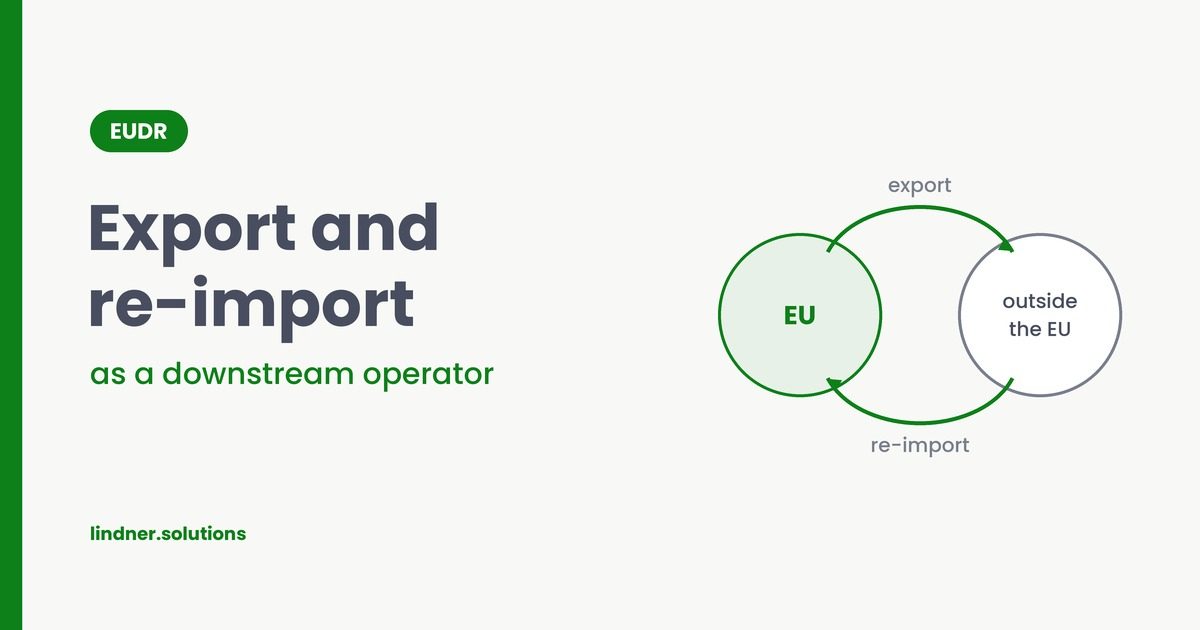
Many companies in the timber chain purchase their wood, paper or cardboard in the EU and sell part of it to buyers outside the EU. Sometimes that material returns later: as a semi-finished product processed outside the EU, or as a finished product for a customer in the EU. Under the EU Deforestation Regulation (EUDR), this raises two questions. What should you, as exporter, state on the export declaration? And what does your EU customer need when re-importing the product?
In the Netherlands, the NVWA will start checking compliance with the rules from 30 December 2026 (Rijksoverheid). Companies with export and re-import in their chain would do well to clarify this now.
Downstream operator: no own statement required upon export
With the amendment of December 2025 (Regulation (EU) 2025/2650), the EUDR recognises the role of downstream operator. This is a company that places on the market or exports products that have already been covered earlier in the chain by a due diligence statement (DDS) or a simplified statement. Such a company does not submit a new DDS.
For export, this means: a downstream operator does not need to state a DDS reference number on the export declaration, but uses an exemption code (Ruokavirasto, Finnish competent authority). In September 2026, the European Commission published an updated TARIC document which, among other things, regulates export by downstream operators (European Commission). According to Dutch Customs, the document codes for export by a downstream operator are Y196 (for large companies) and Y188 (for micro, small and medium-sized companies); Customs adds that these codes are provisional and may still change (Dutch Customs, EUDR document codes). The TARIC document itself, to which the Commission's FAQ refers, is in the Commission's library (TARIC document on CircaBC). This distinction aligns with the registration obligation: large downstream operators and traders register in the EUDR information system, but do not need to submit anything afterwards; SMEs in that role are not required to register (European Commission, Roles and responsibilities).
Note the difference with a company that imported the goods into the EU itself. That company is the operator for those goods and states the reference number of its own statement upon export (Ruokavirasto).
The problem lies with re-import
An importer is in principle an operator who must carry out due diligence itself and submit a DDS. According to the Commission, an importer is only a downstream operator if it can demonstrate that the products, or all relevant products incorporated in them, have already been placed on the EU market before (European Commission, Roles and responsibilities). If this cannot be demonstrated, the product is considered to be imported for the first time. The same rule applies to products made outside the EU from raw materials previously exported from the EU (European Commission, FAQ fifth version, question 5.4).
Your EU customer therefore needs proof upon re-import that the material was already placed on the EU market before. And that proof must largely come from you.
Three routes for your EU customer
- Route 1, the DDS reference numbers. The customer imports using code C720 or C725 and states the reference numbers received from its suppliers. According to Dutch Customs, you use C720 as a downstream operator of large companies and C725 as a downstream operator of micro, small and medium-sized companies, to indicate that you are re-importing goods (Dutch Customs, EUDR document codes). This is the preferred route, as the origin can then be traced directly.
- Route 2, an own DDS. If the customer cannot demonstrate that the material was previously on the EU market, it is simply an operator: full due diligence and a new DDS (FAQ, question 5.4).
- Route 3, without numbers. If no reference numbers have been passed on, the re-importer can, according to the FAQ, use a conventional reference number; the competent authorities are informed of this use (FAQ, question 5.4). The Commission cites the format 22EU2222222222 (European Commission, Roles and responsibilities). The burden of proof lies with the re-importer, so with your customer: before release, it must be able to demonstrate that the product was placed on the EU market and was exported, and provide that evidence to the competent authority on request. Without that evidence, it counts as a first import and a DDS is required. As evidence, the FAQ cites customs declarations, contracts, order documents, transport documents (CMR, bill of lading, delivery note, air waybill), invoices and other credible evidence directly linked to the product. A standalone statement from you is therefore weak evidence. We recommend a file per shipment: the original EU sales invoice, the delivery document or CMR, the DDS reference or a statement from the original operator, the MRN of the export declaration (with Y196 or Y188) and a statement from you, with the link between these documents established through article codes, batch numbers, quantities and invoice numbers. This file is our own approach and not a requirement of the FAQ.
Why the numbers are still preferable
Route 3 sounds simple, but questions remain open. Dutch Customs states that the document codes are provisional; verify them with your customs broker before incorporating them into your processes. The FAQ and the TARIC document are also Commission guidance, not legislation. Also pay attention to the date: code C718 is intended for products placed on the EU market during the transitional period (30 June 2023 until the EUDR enters into application), on export or re-export (Dutch Customs, EUDR document codes) and, according to the FAQ, also on re-import. If your customer's material was placed on the market before 30 December 2026, C718 is the correct code, not C720 or C725. According to the FAQ, a different conventional number goes with it, 99EU9999999999 (FAQ, question 9.2). Whether the NVWA will accept a combination of export declaration, statement and underlying sales documents as evidence is a question we are putting to the NVWA. Until that question is answered, we regard route 3 as a fallback rather than a standard.
In addition, as a downstream company you do not always have the numbers. Only the first downstream operator or trader, the first buyer of the batch that placed the product on the EU market, must collect reference numbers and keep them for at least five years. It is not required to pass them on further, and companies further down the chain do not need to collect them (European Commission, Roles and responsibilities; Regulation (EU) 2025/2650, recitals). Route 1 therefore only works if someone in the chain shares the numbers voluntarily.
What you can do now
- Determine whether you are an operator or a downstream operator for your export flows. This determines which code goes on the export declaration.
- If you are the first downstream party, keep the reference numbers per delivery. Passing them on is not mandatory, but if you voluntarily include them upon export, the party that later re-imports can use route 1.
- Keep the MRN of the export declaration for every export and link it to the corresponding purchase and sales documents.
- Agree with your customers inside and outside the EU on who supplies which data upon re-import.
- Have your customs broker confirm the correct codes before 30 December 2026.
Do you have export flows where the material later returns to the EU, and would you like to know which route works for you and your customers? Feel free to contact us for a brief, no-obligation conversation. [More on EUDR compliance checks →](/eudr)
A question about your own situation?
Call or email for a no-obligation conversation — you always get a personal answer.