
Green claims under EmpCo: the new rules for FSC(R) and PEFC labels and how to apply them
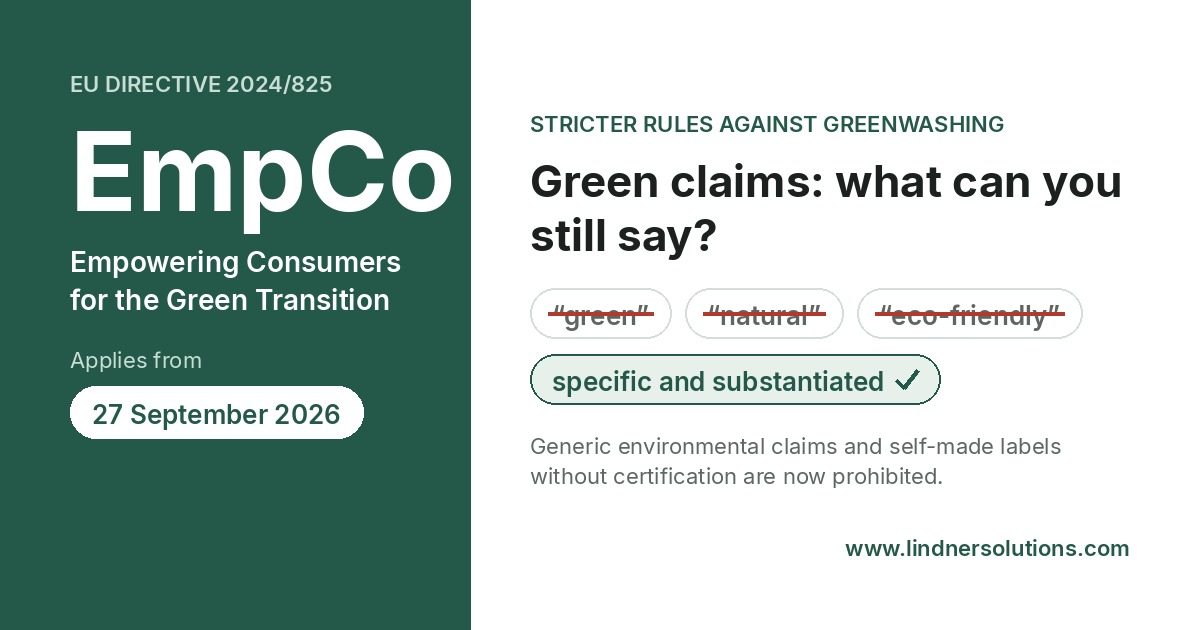
From 27 September 2026, the European Empowering Consumers for the Green Transition Directive (EmpCo, Directive (EU) 2024/825) will apply. Member States were required to transpose the directive into national law by 27 March 2026 at the latest. From now on, stricter rules apply across the EU for environmental claims and sustainability labels aimed at consumers. On 21 September 2026, FSC® published the announcement "As EmpCo raises the stakes for green claims, FSC helps companies communicate with confidence"; PEFC had already indicated in March 2026 that the PEFC system complies with the directive. For companies holding an FSC or PEFC certificate, now is the time to critically review packaging, website and promotional material. Below you can read what the rules are and how to apply them in practice.
What EmpCo prohibits
EmpCo adds a number of practices to the blacklist of unfair commercial practices. These are always prohibited, without a supervisory authority first having to demonstrate that the consumer was misled. The most important ones for the wood, paper and packaging sector:
- Making a generic environmental claim, such as "environmentally friendly", "green", "eco", "natural" or "sustainable", if you cannot demonstrate recognised excellent environmental performance corresponding to that claim. A general term may only be used if the substantiation is provided directly and clearly alongside it, on the same medium.
- Making an environmental claim about the entire product or the entire company, while it only concerns one aspect or one activity.
- Displaying a sustainability label that is not based on a certification system or has not been established by a public authority. Self-invented logos and labels are thereby ruled out.
- Claiming that a product is climate neutral or has a positive climate impact based on offsetting of emissions.
When does a label count as a certification system?
The directive defines what constitutes a certification system, and this is central for FSC and PEFC. It must be a system involving verification by an independent third party, with publicly available requirements, open to all companies able and willing to comply, which consults stakeholders during standard development, has rules for dealing with non-conformities (suspending or withdrawing certificates), and is objectively monitored against a standard. The full text can be found at EUR-Lex.
Both FSC and PEFC state that they meet these criteria: independent, accredited certification bodies, publicly available standards developed with stakeholders, access for any organisation meeting the requirements, and a sanctions policy for non-conformities. Both systems therefore conclude that their labels may continue to be used under EmpCo. Note, however, that this applies to the label itself. What you say around it remains your own responsibility.
FSC: labels, trademark standard and approved claims
FSC states that the FSC 100%, FSC MIX and FSC RECYCLED labels are in line with the directive. Helen Chepkemoi Too, Senior Director of Markets at FSC, summarises it as follows: "EmpCo gives companies a clear choice: make environmental claims they can stand behind, or rethink how they communicate."
The revised trademark standard FSC-STD-50-001 V3-0, which came into effect in 2026, is already aligned with EmpCo. This standard is accompanied by an addendum (FSC-STD-50-001a) containing more than sixty specific, pre-approved environmental claims that certificate holders may use. For claims about climate, biodiversity and ecosystem services, FSC also offers the Verified Impact tool, which allows you to substantiate such statements with verified data. The basic rule remains: any use of the FSC marks must be pre-approved by your certification body, or you must work with an approved trademark use management system. More information can be found on the page FSC & EmpCo: Against greenwashing and in the FSC news item.
PEFC: labels, Label Generator and special membership
PEFC offers the PEFC Certified label (for products containing at least 70% PEFC-certified material), the PEFC Recycled label (for 100% recycled material), and an off-product label for promotional use, for example on your website or in brochures. The rules are set out in the PEFC labelling standard PEFC ST 2001. PEFC indicates that the on-product and off-product labels from the PEFC Label Generator are aligned with the requirements of EmpCo. In practice, this means using the labels and label texts from the Label Generator, together with your own PEFC licence number, and clearly indicating what the label refers to, for example by naming the product. If you wish to deviate from the standard texts, you must request approval to do so.
If you sell PEFC-certified products without being certified yourself, in the Netherlands you may only use the PEFC logo as a special member of PEFC Netherlands (in other countries via a promotional licence). An approved wording in that case is, for example, "[Company name] offers PEFC-certified products". See the page PEFC and the EU Empowering Consumers Directive and the announcement PEFC complies with EU directive on green claims from PEFC Netherlands.
How to apply the rules
The approach is the same for FSC and PEFC. A practical step-by-step plan:
- Take stock of all places where you mention FSC or PEFC or make an environmental claim: packaging, product sheets, website, webshop, social media, quotations, invoices and brochures.
- Use only approved labels and texts: for FSC, the labels from the Brand Hub and the promotional statements from the addendum; for PEFC, the labels and label texts from the Label Generator. Always include your licence code.
- Link the claim to the product. "This product is FSC certified" or "These pallets are PEFC certified" is specific and verifiable. "We work sustainably" is a generic environmental claim, even if a label is displayed alongside it.
- Do not claim more than the certificate covers. An FSC MIX or PEFC Certified claim says something about the origin of the wood or paper material, not about CO2, energy consumption or the entire company.
- Remove or substantiate generic terms. It is better to adjust terms such as "green", "eco", "environmentally friendly" and self-designed leaf logos without certification now rather than after a complaint.
- Have deviations approved: by your certification body for FSC, or via the Label Generator or the national PEFC organisation for PEFC. Keep the approvals in your CoC file, as these are checked during the audit.
- Check the scope. Only products that fall within the scope of your certificate and have been purchased and sold as certified may carry a label or claim.
In the Netherlands, the Authority for Consumers and Markets (ACM) supervises misleading sustainability claims; the ACM's Guidelines on Sustainability Claims align well with the EmpCo approach. Please note that the exact national transposition and enforcement may differ per Member State; check the rules of the relevant supervisory authority for Belgium and Germany.
Get started now
Expect questions from your marketing and sales department in the coming period about what is and is not still permitted. A brief inventory of your communications, compared against the approved labels and statements of FSC and PEFC, quickly provides insight into where you stand.
Would you like to know whether your current FSC and PEFC communications and environmental claims comply with the new rules? In a short, no-obligation conversation, we will review your communications together and determine the best first step.
A question about your own situation?
Call or email for a no-obligation conversation — you always get a personal answer.